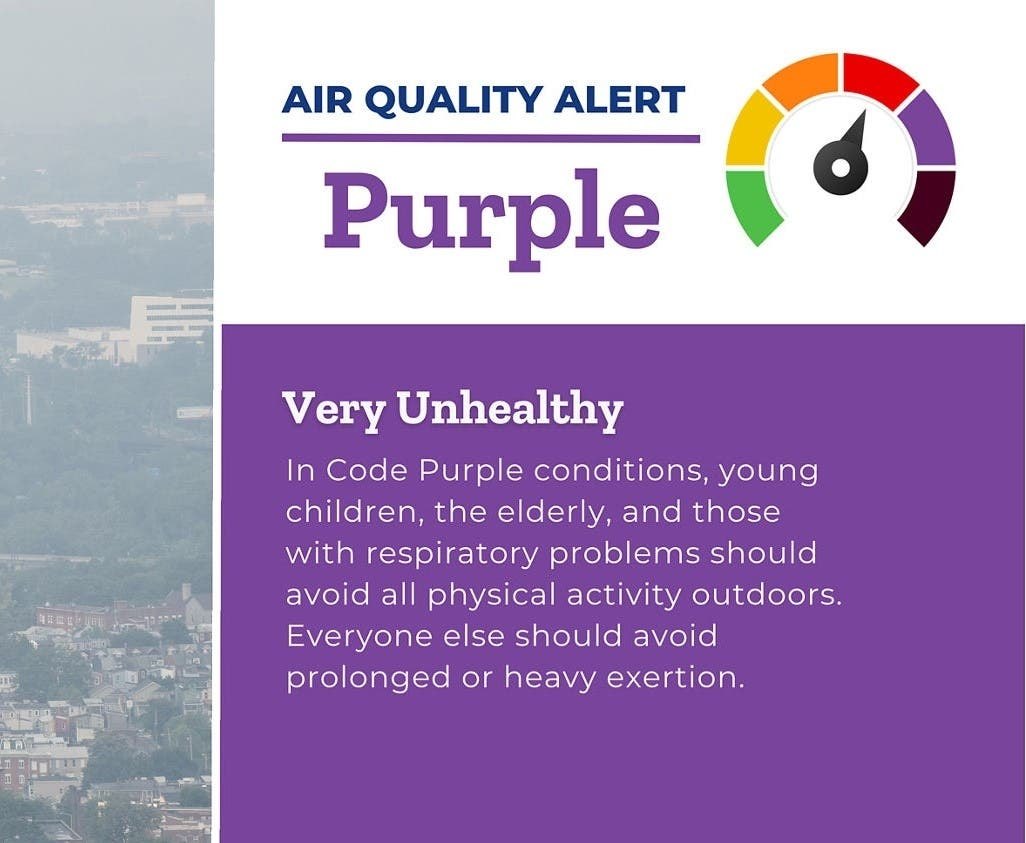
Wildfire smoke from Canada pushed air quality in Bucks County to dangerous levels on Friday, prompting the Pennsylvania Department of Environmental Protection to issue a statewide Code Purple alert for fine particulate matter.
The Code Purple designation means the Air Quality Index has climbed above 200, a level the DEP classifies as "Very Unhealthy" for everyone, not just people with asthma or other respiratory conditions.
The DEP is telling all residents to avoid long or intense outdoor activities. Children, older adults and those with respiratory illnesses should avoid going outside entirely.
Friday's alert marks a significant escalation. On Thursday, the DEP had issued a Code Red alert for the same wildfire smoke and forecast only a Code Orange for Friday. Instead, conditions worsened overnight as smoke from more than 180 wildfires burning in Ontario, Canada and northern Minnesota continued to push southeast into the Mid-Atlantic.
"Wildfire smoke is among the most toxic air pollution that we can have," Ruth McDermott-Levy, co-director of the Mid-Atlantic Center for Children's Health and the Environment at Villanova University, told WHYY on Thursday. "It burns things like wood and other things that are not meant to be burned and breathed."
The fine particulate matter, known as PM2.5, can penetrate deep into the lungs. Even healthy adults may experience burning eyes, coughing, sore throats, or shortness of breath after prolonged outdoor exposure, according to Central Bucks News reporting on the smoke event.
The National Weather Service office in Mount Holly issued an air quality alert at 12:14 p.m. Thursday, July 16, covering both Upper Bucks and Lower Bucks counties. Philadelphia was listed among major U.S. cities at Code Purple levels on Friday, according to AirNow data.
The DEP warned that some areas could reach Code Maroon, the most severe tier, while others may dip to Code Red or Code Orange at different points during the day. Specific AQI readings for Doylestown were not available in published reports.
How to protect yourself
When the AQI is above 200, the DEP and health officials recommend:
- Keep windows and doors closed
- Run air conditioning on recirculate
- Use a HEPA air purifier if available
- Wear an N95 mask if you must go outdoors
- Avoid gas-powered lawn equipment and open burning
When will conditions improve?
Smoke concentrations are expected to remain high through Friday night, according to WGAL's Friday forecast. Conditions should begin to improve Saturday, July 18, as winds shift, with air quality dropping to Code Orange on Saturday and moderate levels by Sunday and Monday.
New Jersey state climatologist John Krasting warned on Thursday, July 16, that residents should not rely on visual cues alone. He told WHYY that even after skies begin to clear, significant pollution can linger at levels invisible to the eye but still harmful to health.
Residents can monitor real-time air quality at airnow.gov or through the EPA's AirNow app.